
- Joined
- Jul 20, 2026
- Messages
- 20
A location in film should be more than a place where actors happen to stand.
Good production design can make a room, house, office, street, or even a single object communicate something about the characters before they say a word. The way a space is arranged, the colours, furniture, lighting, photographs, personal belongings, signs of wealth or neglect all can become part of the storytelling language.
Think about a character entering a house. We might immediately notice that everything is perfectly organised, expensive, and almost impersonal. Without dialogue, we may already sense something about the person who lives there: control, status, perhaps even emotional distance.
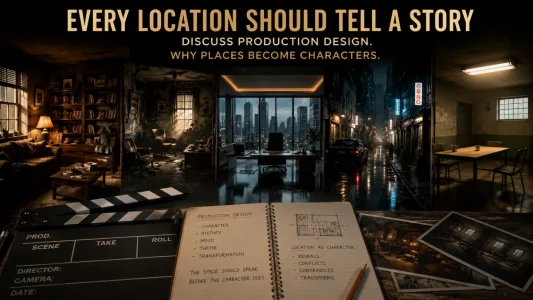
Now imagine another character's home cluttered, warm, filled with photographs, unfinished projects and objects collected over many years. The space tells us something entirely different.
This is where production design becomes narrative.
A location can reveal history. It can show what a character values, what they have lost, what they are hiding, or what they aspire to become. It can establish social class, culture, profession and relationships. Sometimes, the environment can even contradict what a character says.
And the most interesting locations can change meaning as the story progresses.
A dining table might begin as a place of family connection and eventually become the setting for confrontation. A childhood home might initially represent security but later become a reminder of loss. A seemingly ordinary office might gradually feel oppressive as the tension between characters increases.
In that sense, a great location becomes a character without having a single line of dialogue.
This doesn't necessarily mean every production needs elaborate sets or expensive design. Sometimes the most effective production design comes from carefully choosing what to include and what to leave out.
The question I find interesting is:
When you watch a film, how much do you consciously notice the environment and how much does the environment influence your understanding of the story without you even realizing it?
For filmmakers, writers, directors, production designers and film lovers:
Do you believe every significant location should contribute something to the story? And what's a film location that you think did an exceptional job of becoming part of the narrative?
I'd love to hear your thoughts.
Good production design can make a room, house, office, street, or even a single object communicate something about the characters before they say a word. The way a space is arranged, the colours, furniture, lighting, photographs, personal belongings, signs of wealth or neglect all can become part of the storytelling language.
Think about a character entering a house. We might immediately notice that everything is perfectly organised, expensive, and almost impersonal. Without dialogue, we may already sense something about the person who lives there: control, status, perhaps even emotional distance.
Now imagine another character's home cluttered, warm, filled with photographs, unfinished projects and objects collected over many years. The space tells us something entirely different.
This is where production design becomes narrative.
A location can reveal history. It can show what a character values, what they have lost, what they are hiding, or what they aspire to become. It can establish social class, culture, profession and relationships. Sometimes, the environment can even contradict what a character says.
And the most interesting locations can change meaning as the story progresses.
A dining table might begin as a place of family connection and eventually become the setting for confrontation. A childhood home might initially represent security but later become a reminder of loss. A seemingly ordinary office might gradually feel oppressive as the tension between characters increases.
In that sense, a great location becomes a character without having a single line of dialogue.
This doesn't necessarily mean every production needs elaborate sets or expensive design. Sometimes the most effective production design comes from carefully choosing what to include and what to leave out.
The question I find interesting is:
When you watch a film, how much do you consciously notice the environment and how much does the environment influence your understanding of the story without you even realizing it?
For filmmakers, writers, directors, production designers and film lovers:
Do you believe every significant location should contribute something to the story? And what's a film location that you think did an exceptional job of becoming part of the narrative?
I'd love to hear your thoughts.
Last edited by a moderator:


