Steve Behram

New member
Early-Career Professional
Joined
Sep 20, 2026
Messages
3
Location
  1. North America
Role
  1. Producer
Work Type
  1. Hybrid
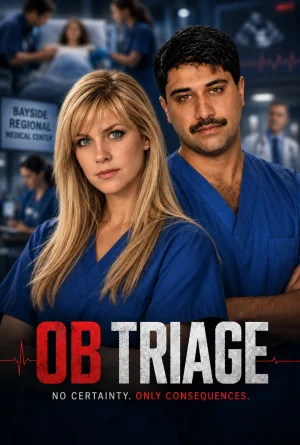
OB TRIAGE is a one-hour ensemble medical drama created and written by Steve Behram, MD, and Nancy Behram, MD—two board-certified OB/GYNs with more than 50 years of combined clinical experience.

Inside a high-pressure OB/GYN training program, exhausted residents navigate medical crises, personal conflicts, and hospital politics while making irreversible decisions with incomplete information—then face morning rounds, where every choice carries consequences for their patients, their careers, and one another.

Set at a Maryland teaching hospital in the 1990s, the series takes place in a world of paper charts, pagers, and wall phones, where connecting the facts depends on tired human beings. Each episode runs three stories at once: the patient story, the training story, and the accountability story. Cases do not end when the patient leaves the room; their consequences return at rounds, in pathology, and in the institutional decisions that follow.

Tone: urgent, intimate, medically authentic, darkly funny, and morally unresolved—in the tradition of THE PITT and ER, but rooted specifically in obstetrics and gynecology.

CURRENT DEVELOPMENT MATERIALS

• Completed pilot
• All ten episodes of Season One written
• Polished pitch deck
• Detailed series bible
• Continuing ensemble and season arcs
• Project website: https://obtriage.com

WHAT WE ARE SEEKING

We are seeking an experienced television producer or executive producer who understands scripted drama and can help move the project from a creator-developed package toward the professional marketplace.

The right partner could help with:

• Assessing and strengthening the package
• Identifying the appropriate production and buyer lane
• Building an attachment strategy for talent and directors
• Approaching production companies and literary representation
• Structuring the next development steps toward a shopping, option, or producing agreement

We are looking for a serious creative and business partner—not paid consulting, generic coverage, or speculative promises. Any producing role, compensation, participation, or rights arrangement would be negotiated transparently and documented according to the individual's experience and contribution.

If the project may fit your interests, please send a brief direct message with your relevant television or producing experience, location, professional profile or IMDb page, and what specifically draws you to OB TRIAGE.

The deck, series bible, and pilot are available privately to qualified industry professionals.

Steve Behram, MD, FACOG
Co-Creator and Writer, OB TRIAGE
 
Genre
  1. Drama
OB TRIAGE is a one-hour ensemble medical drama created and written by Steve Behram, MD, and Nancy Behram, MD—two board-certified OB/GYNs with more than 50 years of combined clinical experience.

Inside a high-pressure OB/GYN training program, exhausted residents navigate medical crises, personal conflicts, and hospital politics while making irreversible decisions with incomplete information—then face morning rounds, where every choice carries consequences for their patients, their careers, and one another.

Set at a Maryland teaching hospital in the 1990s, the series takes place in a world of paper charts, pagers, and wall phones, where connecting the facts depends on tired human beings. Each episode runs three stories at once: the patient story, the training story, and the accountability story. Cases do not end when the patient leaves the room; their consequences return at rounds, in pathology, and in the institutional decisions that follow.

Tone: urgent, intimate, medically authentic, darkly funny, and morally unresolved—in the tradition of THE PITT and ER, but rooted specifically in obstetrics and gynecology.

CURRENT DEVELOPMENT MATERIALS

• Completed pilot
• All ten episodes of Season One written
• Polished pitch deck
• Detailed series bible
• Continuing ensemble and season arcs
• Project website: https://obtriage.com

WHAT WE ARE SEEKING

We are seeking an experienced television producer or executive producer who understands scripted drama and can help move the project from a creator-developed package toward the professional marketplace.

The right partner could help with:

• Assessing and strengthening the package
• Identifying the appropriate production and buyer lane
• Building an attachment strategy for talent and directors
• Approaching production companies and literary representation
• Structuring the next development steps toward a shopping, option, or producing agreement

We are looking for a serious creative and business partner—not paid consulting, generic coverage, or speculative promises. Any producing role, compensation, participation, or rights arrangement would be negotiated transparently and documented according to the individual's experience and contribution.

If the project may fit your interests, please send a brief direct message with your relevant television or producing experience, location, professional profile or IMDb page, and what specifically draws you to OB TRIAGE.

The deck, series bible, and pilot are available privately to qualified industry professionals.

Steve Behram, MD, FACOG
Co-Creator and Writer, OB TRIAGE

Really interesting project. Since medical drama is already a pretty crowded genre, I’d be curious what you feel really sets OB TRIAGE apart from other medical series. What does it offer audiences that they might not get from similar shows?
 
That’s a fair question. Medical authenticity matters, but I agree that it isn’t enough on its own to distinguish a series.

For Nancy and me, the difference starts with the human territory. OB/GYN brings medicine into people’s most private decisions about sex, family, identity, and the futures they imagine for themselves. A delivery everyone calls a success may have been traumatic for the mother. A medically sound recommendation may threaten something a patient values more than her health. We’re interested in those conflicts—not simply unusual diagnoses or dramatic deliveries.

The other defining element is morning rounds as a recurring reckoning. An episode might open with a resident being questioned about an outcome, then take us into the night that produced it. We experience the uncertainty, the competing demands, and the seemingly minor detail that nobody recognized as important. When we return to rounds, the audience understands something the people passing judgment may not. Sometimes that context makes a decision defensible; sometimes it makes the failure more painful. The medical outcome and the judgment of the doctor aren’t necessarily the same story.

There’s also a sustained coming-of-age story across the residency. These are doctors, but they are still becoming the people their patients need them to be. We follow how responsibility changes them: whether they become more compassionate or more guarded, whom they trust, and what they learn to admit—or conceal. The 1990s setting makes that dependence on one another particularly tangible, but it’s not intended as a nostalgia exercise.

Nancy and I began this by remembering the people and situations from our training that stayed with us decades later. Some were devastating; others were genuinely funny. Often, they were both. That combination is what we want to preserve.

Ultimately, we want viewers to do more than wonder whether a patient will be okay. We want them to find themselves thinking, “I understand why that doctor made that choice. I might have made it too.” And then discover what that choice means for everyone involved.
 
That’s a fair question. Medical authenticity matters, but I agree that it isn’t enough on its own to distinguish a series.

For Nancy and me, the difference starts with the human territory. OB/GYN brings medicine into people’s most private decisions about sex, family, identity, and the futures they imagine for themselves. A delivery everyone calls a success may have been traumatic for the mother. A medically sound recommendation may threaten something a patient values more than her health. We’re interested in those conflicts—not simply unusual diagnoses or dramatic deliveries.

The other defining element is morning rounds as a recurring reckoning. An episode might open with a resident being questioned about an outcome, then take us into the night that produced it. We experience the uncertainty, the competing demands, and the seemingly minor detail that nobody recognized as important. When we return to rounds, the audience understands something the people passing judgment may not. Sometimes that context makes a decision defensible; sometimes it makes the failure more painful. The medical outcome and the judgment of the doctor aren’t necessarily the same story.

There’s also a sustained coming-of-age story across the residency. These are doctors, but they are still becoming the people their patients need them to be. We follow how responsibility changes them: whether they become more compassionate or more guarded, whom they trust, and what they learn to admit—or conceal. The 1990s setting makes that dependence on one another particularly tangible, but it’s not intended as a nostalgia exercise.

Nancy and I began this by remembering the people and situations from our training that stayed with us decades later. Some were devastating; others were genuinely funny. Often, they were both. That combination is what we want to preserve.

Ultimately, we want viewers to do more than wonder whether a patient will be okay. We want them to find themselves thinking, “I understand why that doctor made that choice. I might have made it too.” And then discover what that choice means for everyone involved.

You’ve explained really well what makes OB TRIAGE different creatively. But from the financing side, what do you think is the strongest commercial hook? What is the one thing you believe could make an investor or producing partner say, “This is worth backing”?
 
I think the strongest commercial hook is a familiar medical-drama format built around experiences women and their families already have a deeply personal stake in. That gives us a specific audience to reach and a clear reason for them to choose this show.

We would deliberately aim to reach viewers who recognize something of their own lives in these stories: childbirth, fertility, pregnancy loss, a frightening diagnosis, or the experience of struggling to be heard as a patient. Their partners and families have a connection to those experiences too. Our commercial bet is that this recognition can attract people who might not otherwise seek out another hospital drama.

Then the ensemble has to earn their continued attention. A patient’s story can bring someone into an episode; attachment to the residents, their relationships, and the consequences they carry forward gives that viewer a reason to return. The series combines self-contained medical stories with character and institutional arcs that accumulate across the season.

Nancy and I bring a firsthand source of material, and with all ten first-season episodes written, a prospective partner can evaluate whether we have actually sustained that promise beyond the pilot. They don’t have to assess it from a concept alone.

The budget, casting, and buyer strategy still need to make commercial sense. But the reason I believe the project is worth developing is specific: we’re aiming for the viewer who says, “That could have been me,” and stays because they need to know what happens to the people in that hospital. That is the audience connection we would be asking a producing partner to help us build into a business.
 
Back
Top