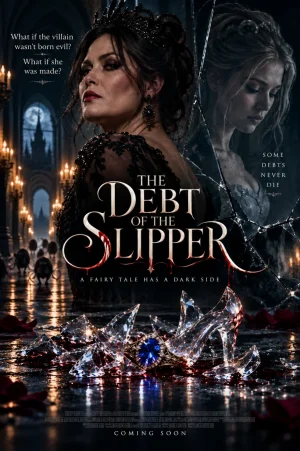
Question THE DEBT OF THE SLIPPER – Gothic Cinderella Origin Story

Washingtoninkgirl

New member
Early-Career Professional
Joined
Sep 23, 2026
Messages
15
I’m developing The Debt of the Slipper, a dark gothic reimagining of Cinderella that asks a different question: What made the stepmother become the woman we know?

The story follows Eleanora across roughly thirty years, beginning long before Cinderella enters her life, and explores the love, grief, resentment, and choices that slowly transform her.

Rather than retelling Cinderella’s story, I wanted to build an origin story around the character audiences already believe they understand.

I’d love feedback on the concept, tone, and whether this is a dark fairy-tale story you’d want to see on screen.
 
Genre
  1. Drama
  2. Thriller
  3. Horror

Attachments

  • debt of slipper poster.webp
    debt of slipper poster.webp
    206.2 KB · Views: 0
Interesting angle. Do you see Eleanora as someone the audience should eventually sympathize with, or is the goal more to understand how she became the character we know without necessarily forgiving her?
 
My goal is more for the audience to understand how Eleanora became the woman we know, without necessarily forgiving her. I want them to sympathize with who she was and recognize that she once genuinely loved and had hope. But as grief, resentment, and bitterness reshape her, she still makes choices that ultimately belong to her. For me, that’s the tragedy of the character. By the end, I want the audience to understand her without excusing her.
 
As someone who grew up with almost every possible Disney VHS, I absolutely love the idea of this. Keeping it as a back-story is a great concept but I would hope that it doesn't veer towards the sympathy side. In truth - as a major Disney movie fan over the years - I would prefer to hate her more by the end of it.

Out of curiosity - who would be the antagonist in this idea?

- Mark
 
Thanks, Mark. That’s actually one of the things I wanted to explore with the story. I don’t want the audience to excuse Eleanora or necessarily sympathize with the woman she ultimately becomes. I want them to understand how she got there, and then watch her make increasingly darker choices until she essentially becomes the antagonist of her own story.


There are other dark forces surrounding her, including Nix and Scut, but I’ve been careful not to let them become an excuse for her behavior. Eleanora still has agency in the choices she makes.


And this isn’t a Cinderella story where Cinderella simply gets her happily ever after. The tragedy carries all the way through the ending. I want the audience to leave understanding how Eleanora became the woman they know, but also questioning how they feel about what happened to Cinderella and whether anyone truly won.


My hope is that the ending hurts a little. It’s still a fairy tale, just one that doesn’t let the audience off quite so easily.
 
Thanks, Mark. That’s actually one of the things I wanted to explore with the story. I don’t want the audience to excuse Eleanora or necessarily sympathize with the woman she ultimately becomes. I want them to understand how she got there, and then watch her make increasingly darker choices until she essentially becomes the antagonist of her own story.

There are other dark forces surrounding her, including Nix and Scut, but I’ve been careful not to let them become an excuse for her behavior. Eleanora still has agency in the choices she makes.

And this isn’t a Cinderella story where Cinderella simply gets her happily ever after. The tragedy carries all the way through the ending. I want the audience to leave understanding how Eleanora became the woman they know, but also questioning how they feel about what happened to Cinderella and whether anyone truly won.

My hope is that the ending hurts a little. It’s still a fairy tale, just one that doesn’t let the audience off quite so easily.

I really like that distinction. Making Eleanora the antagonist of her own story is much more interesting than giving her an external force to blame.

The key may be making each darker choice understandable in the moment, while still letting us see that she could have chosen differently. Watching the person she might have been slowly disappear could be what makes the tragedy and the ending really hit.
 
That’s actually exactly how I’ve written Eleanora’s arc. Each darker choice makes sense to her in the moment, but there are points where she could have chosen differently. Thomas, especially, gives us a glimpse of the woman she might have remained, and after losing him, we slowly watch that part of her disappear. By the end, I wanted the tragedy to come from knowing she wasn’t destined to become this person. She became her through the choices she made.
 
Back
Top